Showing posts with label IBR. Show all posts

Friday, October 22, 2010

Should I Consolidate My Student Loans?

Keeping up with all your different student loans can be a hassle. If you borrowed money from multiple lenders, you may have difficulty keeping up with all the due dates now that you have to start paying off your loans. One option that may help you is loan consolidation. Like many things in life, loan consolidation has its advantages and disadvantages.

Advantages

  • One payment to one lender- With consolidation, you only make one monthly payment and you have one lender- the Department of Education.
  • Lower Monthly Payment- Your payments are lower because you have longer repayment period. Under the standard repayment plan, your payment period can be up to 30 years.
  • A fixed rate- Your consolidated loan will have a fixed interest rate during the life of the loan. Your rate is based on the weighted average of all your consolidated loans. Your interest rate will not exceed 8.5%.
  • No Minimum or Maximum Loan Amounts or Fees- Consolidation is free.
  •  No penalty for paying off your loan early
Disadvantages

  • More interest- Since you have an extended repayment period, you will pay more in interest over the long term.
  • Loss of benefits. With consolidation you will longer be able to take advantage of certain incentives such as loan cancellations and interest rate reductions.
  • Higher interest rate- The interest rate on your consolidated loan may be higher than the interest rates on you individual loans.
Consolidating your loans can help you if your individual monthly loan payments are too high, but consider ALL your options before you consolidate. If your payments are too high, contact your lender and try to switch payment plans. Remember the IBR plan allows you to make monthly payments according your income. Consolidation is a good option, but consider what you give up before you consolidate your loans.

NOTE: DO NOT consolidate your federal student loans with your private student loans. When you mix the two types of loans, you loans are no longer backed by the government and you have a private lender. You lose all the benefits you have with your federal student loans when you consolidate with a private lender.

For more information about loan consolidation, visit http://www.loanconslidation.ed.gov/.

All information presented only relates to Federal student loans and is provided by the Department of Education. If you have private student loans, contact your lender(s).

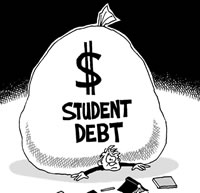
Friday, October 15, 2010

Paying Off your Student Loans


For those of you who graduated in May 2010, your grace period is quickly coming to an end. I’m sure you receive letters from your student loan creditors every other week.  Although you wish your debt would just go away, you have to pay off your student loans (unless you want your credit to go down the toilet.)  The Department of Education has several payment plans to help you pay off your debt. Here is a breakdown of some of the most common plans.

Standard
This plan gives you 10 years to pay off your debt. Your monthly payment will be a fixed amount of at least $50. You may have a higher payment with this plan, but you will pay less in interest since you have a shorter payment period.

Extended
Under this plan, you have 25 years to pay off your loans. You will have a lower payment, but you will pay more in interest because you have a longer repayment period. There are some restrictions with this plan. If Direct Loan is your creditor, you must have more than $30,000 in Direct Loans. If FFEL (Federal Family Education Loan) is your creditor, you must have more than $30,000 in FFEL Program loans.

Graduated
With this plan, your payments start out low and increase every two years. This plan also gives you 10 years pay off your loans. This plan is good if you expect your income to steadily increase over time.

Income Based Repayment Plan (IBR)
The Income Based Repayment Plan started in 2009. Under this plan, your payment is based on your income and family size. You are eligible for this plan if your monthly payment is lower under IBR than under the standard plan. This plan also comes with a few incentives. If you repay under IBR for 25 years and meet other requirements, your remaining debt can be cancelled.  If you work in public service and repay under IBR, your remaining debt can be cancelled after 10 years in public service. While this plan does have incentives, it also has disadvantages. Because you are making a lower payment, you may pay more in interest. You also have to send your lender documentation about your income and family size every year. You can get an estimate of your payment under this plan by using IBR caluclator.
For more information on all these plans, visit nslds.ed.gov.


NOTE: Paying off your student loans may feel overwhelming, but remember you made an investment in yourself. People pay $50,000 for a luxury car that depreciates as soon as they drive it off the lot and pay it off within 5 to 10 years. Your earnings and career appreciate overtime with your degree. Don’t stress, make your payments on time, and focus on your new career.

All information presented only relates to Federal student loans and is provided by the Department of Education. If you have private student loans, contact your lender(s) for repayment options.