Showing posts with label money. Show all posts

Friday, October 29, 2010

My Time is Up


It’s been fun going on this financial journey with you, but my time is over. I am leaving my credit union to pursue other opportunities. Although my original purpose was to help you, I have learned a lot myself. While I suck at sticking to a budget, it’s nice to know where my money goes now and I will do my best to live on a budget in the future.  I’m also fully prepared to pay my student loans when my lenders harassing me for their money. My next destination on this journey will be another blog- Broke College Grad.  You can get all the links to the recent grad information on this site on my Tumblr. I will post new information soon. Hope you have enjoyed this site. Stay financially free!

Thursday, October 28, 2010

30 Day Spend and Save (Budget) Challenge Update: I Give Myself a D+

My 30 Day Spend and Save Challenge is coming to a close.  If I had to give myself a grade for this challenge, it would be D+. The only reason I did not give myself an F is because I did save some money towards my goals.  I have learned about myself and money while doing this challenge. Here’s what I learned.

I LOOOVEEE to shop. I also love to eat out and go out with my friends.  I exceeded my clothes, entertainment, fast food, and restaurants budget.  All of this fun and pretty clothes adds up to a whopping $593. 14. Holy cow! My original clothes, entertainment, and restaurants budgets combined equaled $450. I spent an extra $143.14. This is money I could have put towards my emergency fund or moving fund.

Budget more money for the essentials. Sometimes I think my car hates me! Since my car was born in the mid-90s, it’s not very fuel efficient and it burns gas easy. I should have allocated an extra $50 in my budget for gas. Even though I’m not primarily responsible for groceries, I also should have put more money in my budget for groceries.

Budget for other expenses. Throughout this challenge, I had unexpected expenses. I had to renew my AAA membership, buy a lock for my gym locker, take some clothes to the cleaners, and pay for this job subscription service. (I’m thinking of cancelling that subscription.) I also had to pay for transportation for the trip I took to Philly this month. I will definitely add a miscellaneous category to my spending plan.

While I did exceed my budget, I’m not going to beat myself up. This was my first time ever trying to live within a budget and I learned a lot.  I’m taking all the lessons I learned from this month and using them to make adjustments in my budget and spending habits. Hopefully, I will be able to give myself a better grade next month.

Tuesday, October 26, 2010

5 Myths about Credit Unions

Since the stock market crashed in 2008, many people have been angry at the “Too Big to Fail Banks.”  Arianna Huffington, Co-founder and Editor-in-Chief of the Huffington Post, even started the “Move Your Money” campaign to encourage people to move their money from big banks into local banks and credit unions. While some people may be tired of their bank, they continue to bank with them. I don’t understand it.  Credit unions are a great alternative to big banks, but there are many myths about credit unions. Well it’s time for me to debunk these myths and give you the truth.

Myth #1: Your Money is Not Safe.
Fact: Credit Unions are just as safe as banks. Deposits in credit unions are insured by the National Credit Union Association up to $250,000. Many credit unions also pay a fee to the National Credit Union Share Insurance Fund to insure your deposits.

Myth #2: Credit Unions are Just like Banks.
Fact: While credit unions offer many of the same services as banks, their mission is different. Banks work to make a profit, but credit unions work to serve their members. As a credit union member, you are part owner and you have a say in how the credit union operates.

Myth #3: They’re not convenient.
Fact: Many credit unions are a part of cooperative networks that give their members access to thousands of ATMs and branches around the country.  With these cooperative networks, you can walk into any credit union to complete your transaction like you were at your credit union.

Myth #4: You can’t belong to a Credit Union unless you work for a certain employer or join a union.
Fact: It’s true that credit unions have membership qualifications, but most people can join credit unions. There are many credit unions that allow you join if you live, work, worship, or go to school in a certain area. You also may able to join a credit union through a family member or by being a member of an organization.

Myth 5: You have to pay a fee to join a credit union
Fact: The "membership fee" is actualy a small minimum balance you must maintain in a savings account. This balance makes you a member of the credit union. It usually is $5 to $25. You can get this money back if you decide to leave the credit union.

Now that you know the truth, may be you should consider joining the "Move Your Money" campaign. You'll be happy that you did.

Monday, October 25, 2010

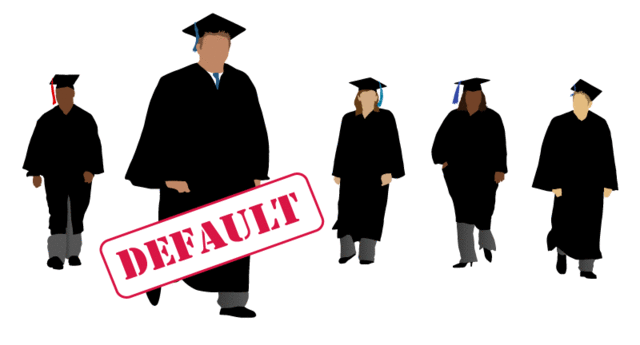
Don’t Default on Your Student Loans!

Congratulations!!! You have to start paying off your loans within the next month! YAY!!! (OK. I’m sorry for the sarcasm.) Many recent grads are still struggling to find work and making student loan payments may be tough. Despite the fact that you may unemployed or underemployed, whatever you do, do NOT default on your student loans. DON'T DO IT! DON’T…DO…IT! Not paying back your student loans can get you into a lot of financial trouble. The following things can happen if you are delinquent in your loan payments:
  • Your entire loan balance will be due immediately.
  • You lose eligibility for loan deferment.
  • You won’t be eligible for additional federal student aid. (You do want to go to grad school right?)
  • Your account will be turned over to a collection agency and you will have to pay additional charges, late fees, and collection costs.
  •  Your credit will go down the toilet. Since your credit will be trash, you might not qualify for credit cards, a car loan, a mortgage, or renting an apartment or you’ll qualify for an astronomical interest rate that will cost you more money.
  • Forget about a tax refund.
  • Uncle Sam will garnish your paycheck if you ever do find a job.
  • It may take longer for you to find a job or get a professional license if employers do credit checks.

I understand if you have bills that are high as the sky, but you have options if you cannot afford to make your student loan payments. Remember you can apply for a deferment or forbearance. You can also consolidate your loans or switch your payment plans. There is no excuse for you not to be responsible and take care of your student loans. If you don’t, it will cost you in the future. (I warned you.)

All information presented only relates to Federal student loans and is provided by the Department of Education. If you have private student loans, contact your lender(s).

Friday, October 22, 2010

Should I Consolidate My Student Loans?

Keeping up with all your different student loans can be a hassle. If you borrowed money from multiple lenders, you may have difficulty keeping up with all the due dates now that you have to start paying off your loans. One option that may help you is loan consolidation. Like many things in life, loan consolidation has its advantages and disadvantages.

Advantages

  • One payment to one lender- With consolidation, you only make one monthly payment and you have one lender- the Department of Education.
  • Lower Monthly Payment- Your payments are lower because you have longer repayment period. Under the standard repayment plan, your payment period can be up to 30 years.
  • A fixed rate- Your consolidated loan will have a fixed interest rate during the life of the loan. Your rate is based on the weighted average of all your consolidated loans. Your interest rate will not exceed 8.5%.
  • No Minimum or Maximum Loan Amounts or Fees- Consolidation is free.
  •  No penalty for paying off your loan early
Disadvantages

  • More interest- Since you have an extended repayment period, you will pay more in interest over the long term.
  • Loss of benefits. With consolidation you will longer be able to take advantage of certain incentives such as loan cancellations and interest rate reductions.
  • Higher interest rate- The interest rate on your consolidated loan may be higher than the interest rates on you individual loans.
Consolidating your loans can help you if your individual monthly loan payments are too high, but consider ALL your options before you consolidate. If your payments are too high, contact your lender and try to switch payment plans. Remember the IBR plan allows you to make monthly payments according your income. Consolidation is a good option, but consider what you give up before you consolidate your loans.

NOTE: DO NOT consolidate your federal student loans with your private student loans. When you mix the two types of loans, you loans are no longer backed by the government and you have a private lender. You lose all the benefits you have with your federal student loans when you consolidate with a private lender.

For more information about loan consolidation, visit http://www.loanconslidation.ed.gov/.

All information presented only relates to Federal student loans and is provided by the Department of Education. If you have private student loans, contact your lender(s).

Thursday, October 21, 2010

Happy International Credit Day!


Today is International Credit Union Day! Credit unions have been serving communities with financial services for over a hundred years. Despite their long presence, many people still do not know what a credit union is. With all of the turmoil in the financial sector, credit unions are a good alternative to the “Too Big to Fail Banks.”

This morning I read a guest post from our friends over at Budgets are Sexy about a terrible customer service experience at Bank of America. T. Penny tried to refinance his home with Bank of America and they gave him the run around. They also screwed him out of $863.33. Towards the end of his post, he said, “Nurture me, big banks!” I have some news for you T. Penny. It ain’t gonna happen! Big banks are only in business for themselves and to make money. That is why they engaged in risky lending practices and lead us into this deep recession. However, you will get the tender, love, and care you need at a credit union.

Since credit unions are not for profit institutions, they are there to help you. You are not just a number at a credit union, but you are a member. This means you have a say in how your credit union operates. You get to vote for the Board of Directors and serve on committees. There is not a small group of people waiting to receive an enormous bonus at the end of the year.  You also can receive lower rates on loans, higher rates on deposits (savings), lower fees, and personable service. Many credit unions also offer financial counseling to help you get your finances straight.

If you are tired of being taken advantage of by your bank, it’s time to boycott your bank. Credit unions will welcome you with open arms. On this International Credit Union Day, stop by your local credit union and ask them how they can help you. Many credit unions across the country are having celebrations for this special day and would love to talk you. Happy International Credit Union Day!

For MD, D.C., VA residents, visit whatsinitforme.org to find a local credit union.

Wednesday, October 20, 2010

So You Can’t Afford to Pay Your Student Loans

Since the day you gradated, the student loan people have been on your back by sending you letters every week. I have some bad news and good news for you my recent grad. The bad news is the only way you can get out of paying your student loans is if you DIE! The good news is you do have a few options if you cannot afford to pay your loans back at this time.  Here’s a breakdown of your options.


Deferment
Every graduate has a grace period of at least six months, but you can also defer your loans. A deferment is a temporary suspension of repayment on your principal loan balance for specific period of time. You do not have to pay interest on subsidized loans during deferment, but you must pay it on unsubsidized loans. If you do not pay the interest on your unsubsidized loans, it will be added to your balance and you will pay more money. You qualify for a deferment under the following conditions:
  • Enrolled in school at least part time
  • Studying in an approved graduated fellowship program or in an approved rehabilitation training program for the disabled
  • Unemployed(Deferment up to three years)
  • Economic hardship{Deferment up to three years (including Peace Corps)}
  • A member of US Armed forces reserve or the National Guard.  You must be called or ordered to active duty while in school at least part time or within six months of having been enrolled at least half-time.
Forbearance
If you do not qualify for deferment, you can apply for a forbearance. A forbearance allows you to postpone or reduce your monthly payments for a specific time period due to financial hardship or illness. You are responsible for paying the interest on both subsidized and unsubsidized loans. If you do not pay the interest, it will be added to your principal balance and you will pay more money.


Along with deferment and forbearance, there are also loan forgiveness programs.

Teacher Loan Forgiveness Program
You can get up to $17,500 of your loans cancelled under this program! You have to teach in a low income elementary or secondary school for five consecutive years. There are some conditions. To receive up to $17,500 in loan forgiveness, you must be a math or science teacher in a secondary school or a special education teacher. You receive up to $5,000 in loan forgiveness if you are an elementary teacher or secondary teacher that teaches a subject that relates to your major. If you are an aspiring educator or thinking about going into education, take advantage of this program. The world needs more great teachers.

Public Service Employees
With this program, your remaining balance can be forgiven after you made 120 payments. Only federal Direct Loans qualify for this program, but you can have your other federal student loans consolidated into a Direct Loan to take advantage of this program. You qualify for this program if you are employed full time in the following sectors:

  • A federal, state, local, or tribal government organization, agency, or entity including public schools, colleges and universities
  • A public child or family service agency
  • A 501(c)(3) non-profit organization
  • Tribal college or university
  • A private organization that is a not for-profit business, labor union, partisan political organization, or religious organization provides the following public services
    • Emergency management
    • Military service
    • Public safety, public health, public education, or public library services
    • Law enforcement
    • Public interest law services
    • Early Childhood services
    • Public service for individuals with disabilities and the elderly
    • School library or other school-based services
These programs can really work for you. For example, let’s say you have $43,000 in loans. You are a preschool teacher that makes $24,000 a year and you are single with no children. You choose the IBR plan and your loan payments are $95 a month. If you were to make 120 payments of $95, you are only paying back $11,400 of your $43,000. I understand that life circumstances could change with this example, but you still won’t pay anywhere close to your original balance. Remember people buy $40,000 cars (which depreciate in value) and pay it off in less than 10 years. If you use these programs, you don’t even pay full amount of your loans and your income will increase over time with your degree. Don’t be discouraged by your debt. Take advantage of these programs, make your payments ON TIME, and you will succeed.

All information presented only relates to Federal student loans and is provided by the Department of Education.  For more information about these programs, visit studentaid.ed.gov. If you have private student loans, contact your lender(s).

Monday, October 18, 2010

30 Day Spend and Save Challenge Update: I Don’t Know if This (Budget) is Going to Work

This past weekend, I went to Philly for homecoming at my Alma Mater (Temple U.) and to celebrate my birthday with my friends. I had a blast! But I think I threw my spending plan out of the window.  I spent more than $200 in 3 days.  This is the cost of my cell phone bill and gas for an entire month! Where did all that money go you ask? It went to clothes, food, hair, transportation, and parties. If you remember from my past updates, I already exhausted my clothes budget and restaurant budget. Since I went over budget in these areas, I had to apply these purchases to other categories. I no longer have any money in my hair, skin care budget, or fast food budgets.  I noticed that I did not allocate enough for gas money, so I might go over that budget too. I have $77 left in my entertainment budget and I just started celebrating my birthday. (My birthday is tomorrow-10/19.)  There are still 12 days left in this month.  I don’t think I’m going to stay within my overall spending plan. I need help.

Friday, October 15, 2010

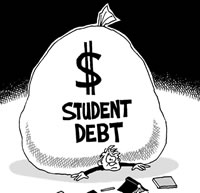
Paying Off your Student Loans


For those of you who graduated in May 2010, your grace period is quickly coming to an end. I’m sure you receive letters from your student loan creditors every other week.  Although you wish your debt would just go away, you have to pay off your student loans (unless you want your credit to go down the toilet.)  The Department of Education has several payment plans to help you pay off your debt. Here is a breakdown of some of the most common plans.

Standard
This plan gives you 10 years to pay off your debt. Your monthly payment will be a fixed amount of at least $50. You may have a higher payment with this plan, but you will pay less in interest since you have a shorter payment period.

Extended
Under this plan, you have 25 years to pay off your loans. You will have a lower payment, but you will pay more in interest because you have a longer repayment period. There are some restrictions with this plan. If Direct Loan is your creditor, you must have more than $30,000 in Direct Loans. If FFEL (Federal Family Education Loan) is your creditor, you must have more than $30,000 in FFEL Program loans.

Graduated
With this plan, your payments start out low and increase every two years. This plan also gives you 10 years pay off your loans. This plan is good if you expect your income to steadily increase over time.

Income Based Repayment Plan (IBR)
The Income Based Repayment Plan started in 2009. Under this plan, your payment is based on your income and family size. You are eligible for this plan if your monthly payment is lower under IBR than under the standard plan. This plan also comes with a few incentives. If you repay under IBR for 25 years and meet other requirements, your remaining debt can be cancelled.  If you work in public service and repay under IBR, your remaining debt can be cancelled after 10 years in public service. While this plan does have incentives, it also has disadvantages. Because you are making a lower payment, you may pay more in interest. You also have to send your lender documentation about your income and family size every year. You can get an estimate of your payment under this plan by using IBR caluclator.
For more information on all these plans, visit nslds.ed.gov.


NOTE: Paying off your student loans may feel overwhelming, but remember you made an investment in yourself. People pay $50,000 for a luxury car that depreciates as soon as they drive it off the lot and pay it off within 5 to 10 years. Your earnings and career appreciate overtime with your degree. Don’t stress, make your payments on time, and focus on your new career.

All information presented only relates to Federal student loans and is provided by the Department of Education. If you have private student loans, contact your lender(s) for repayment options.

Tuesday, October 12, 2010

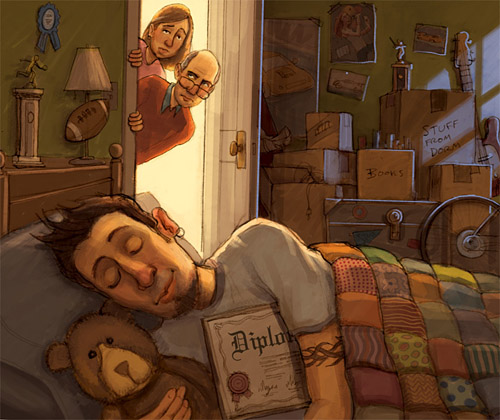
Maybe You Should Leave the Nest

I understand that moving back home after college is not for everyone.  You may not get along with your parents or you just do not want to give up your freedom. Moving home does has its drawbacks.

 Lack of Privacy


For the past four years, you could come and go as you please. No one was there to nag you about where you were going and what time you were coming home. You could do what you want without your parents having a clue. When you live at home with mom and dad, you have to live by their rules. This means letting them know when and where you are going to get your next hangover. You also may not be able to bring that hot girl/guy you just met at the club home. For some of you, moving home may put your dating life on ice.

Squander Your Money


Without the responsibility of paying bills, you have more discretionary income. It’s easy to blow your money on clothes, vacations, gadgets, and anything else your heart desire. This defeats the purpose of  you living at home to save for your own place or pay off debt.

Regression

The purpose of you moving back home is to get your life together. With mom doing the cooking and cleaning, it’s easy to get comfortable living at home and lose motivation to stand on your own two feet. You begin to depend on your parents to do everything for you. You parents also may treat you like the teenager that left 4(5,6) years ago. After all you are their “baby.”

I’ve experienced some of these drawbacks living at home. My shopaholic tendencies are starting to show again and I’m not always motivated to go after different opportunities. While I prefer not to live at home, I can deal with mom’s craziness until I save enough to survive on my own again. However, everyone is different. Some people prefer to struggle to make it on their own than give up their freedom.  If you feel that living at home is stifling your growth as a man or woman, maybe you should move out.  You decide what’s best for you.

A Perfect Example of Why You Need an Emergency Fund


Last Friday, I had a great start to my day. I locked my keys in my car! Thankfully, I had AAA membership so handling this situation was easy…so I thought. When I called AAA for them to unlock my car, I discovered that my membership was expired. I renewed my membership because I needed to get my work day started.  That cost me $101.25. For a recent grad trying to build her savings, that’s a lot of money. Thankfully, I had the money pay for it.  This kind of situation happens all the time, but what would of happened if I didn’t have the money? What would have happened if I didn’t have a budget and spent every dime of my paycheck? I would of have been out of luck! Life happens all the time. You car gets a flat tire, you lose your job, you get sick, or someone dies. Not having money to cover emergency expenses causes more stress in emergency situations. If you don’t have an emergency fund, start one! Even if you can only save $5 a paycheck, something is better than nothing.

Need to find somewhere to place your rainy day fund, click here.

Wednesday, October 6, 2010

10 Common Money Mistakes Made by Recent Graduates

Since I'm a recent grad, I decided to do my next series on recent graduates. All my fellow recent graduates know it's hard trying survive in this rough economy. We are bound to make mistakes now that we are in the real world. I found these common mistakes from a guest post over at realmofprosperity. For each mistake, I'm going to tell whether I'm guilty or innocent.

1. Overspending on the wardrobe. Guilty
I love to shop and I get bored with my wardrobe. After struggling through college and working a minimum wage job during the summer, I felt rich once I got my first paycheck from my current job. It feel good to not worry about bills and to spend money on things I wanted. While I needed work attire, I could of bought a few pieces at a time instead of going on two shopping sprees.If you need a work wardrobe, buy a few quality pieces at a time. Use coupons and shop sales and clearances whenever you can.

2. Partying and drinking more while out of school.  I Plead the 5th.  I’m not sure where to place myself.  It’s okay to go out, but if you are fortunate to have a job just remember you have to get up for work in the morning. If you don't have a job, you can be using that money for your job search. You can spend a lot of money going to happy hours or going to clubs every weekend. It is also not wise to play Mr or Ms. Big Shot and pick up the tab for everyone.You are only fooling yourself and wasting your money. Skip happy hour sometimes and find cheaper alternative ways to have fun. Your body and wallet will thank you for it.

3. Eating out too much. Guilty.  I’m guilty because I don’t mind spending $30 or $40 on a meal. (I know, a waste.)  Eating out can be expensive and it can affect your health. Learn how to cook some of your favorite restaurant meals. It may not always taste the same, but you can control amount of calories you’re consuming and save money.

4. Buying swanky gadgets.  Innocent. Even though I want a Mac, I have not spent my savings on a new laptop. (Although my current laptop almost blew out on me.)  The money you want to use to buy a new iPhone, plasma TV, or laptop can go towards your student loan payments. Your current gadgets are good enough until you can afford to buy the latest and greatest gadgets.

5. Abusing the credit cards. Innocent. My mom yelled at me for four years, “ Don’t get a credit card cause I will not help you pay the bill!” I was a good girl and I listened. All I have to worry about is my $50,000 of student loan debt. Woo hoo!!! For those of you who have credit cards, it’s easy to get caught up and start using credit cards to pay for things. You’re making big money now so you can just pay if off later right? WRONG! Or you can use credit cards to get by until you find a job right? WRONG AGAIN! Do not abuse your credit cards with the intention of worrying about it later. Never be tempted to carry a balance on your credit card.  Always pay the full balance.

6. Not being savvy when grocery shopping.  Guilty. One tip my mom gave me to eat what was on sale. I didn’t always do this when I was living on my own. I also didn’t use coupons. Using coupons may make you feel like a soccer mom(no offense to soccer moms), but you will save money on your grocery bill. Look through the supermarket circulars to find sales and use coupon sites.

7. Celebrating with an expensive trip. Innocent. My dream last year was to backpack around the world for an entire month after graduation. Good thing my money did not allow me because I was able to focus on my career. As recent graduates, we do feel entitled to a trip after putting our blood, sweat, and tears into getting a degree, but it may not be the best idea. Vacations cost money that you may not have and you need to focus on starting your career. You will have plenty of time to travel and enjoy the good life once you are established in your career.

8. Purchasing a new set of wheels. Innocent. I am driving the purple bucket that my dad left me. I hate my clunker as much as the next college grad, but buying a new car can become a financial burden. Buying a new car gives you more debt on top of your student loans and credit cards. A new car also depreciates in value as soon as you drive it off the lot. Get as many miles off your clunker and drive it until the wheels fall off. If you must buy a new car, buy a gently used car.

9. Renting a new crib by yourself. Innocent. While it may be nice to have a place all to yourself, a roommate cuts expense. You might be tired of living with other people, but you save money in the long run. You can put that extra money into savings for a house. You can also do what I did and move back in with your parents for awhile. Mom and Dad might nag you, but dealing with them allows you to save for a house too.

10. Forgetting to save for retirement. Guilty. When you are young, retirement seems sooooooo far away, but it’s important to start early. If you start saving now, you will have a lot more money than someone who starts saving in their 30s or 40s. Sign up for your company’s 401k plan especially if they match your contributions. If your company does not offer retirement plans, you can set up a Roth IRA. Since I haven’t found a permanent position, I am looking into various Roth IRAs offers.

I’ve been charged with four counts of recent grad mishaps. I guess I’ll start serving my sentence now-sticking to my spending plan and researching IRA accounts. What mistakes have you made as a recent grad?

Contributors: Mr Credit Card www.askmrcreditcard.com.

Friday, September 24, 2010

I Made A Spending Plan(Budget) and I Don't Like It!

I’m trying my hardest not to use that dirty word (budget), but I have slight anxiety over this spending plan thing. I made my spending plan and I do feel a little restricted. Let me explain some things about me. I love shopping, going out with friends, and having fun. I also like nice things and don’t have a problem spending money. My spending plan probably reflects all of these things. I am going to start following my spending plan next week, October 1. I’m a little scared that I’m not going to follow it especially since my birthday is next month. I usually spend a good amount of money celebrating my birthday. I need your help, so I can stick to my spending plan. Take a look at it and tell me if I should make any changes. Keep in mind that I’m a recent college grad that lives with her mom. This means I do not have a lot of bills, but I’m trying to move out of her house around this time next year. I need all the help I can get!

My Monthly Spending Plan


Income
Paycheck1550
Total1550
Expenses
Needs
Gas100
Cell Phone100
Food
Groceries40
Clothing200
Emergency Fund200
Moving Fund300
Hair120
Tithes/Offerings/Charity 200
Total1260
Wants
Food
Fast Food10
Restaurants40
Entertainment200
Skin Care20
Total270
*Extra Money20