Showing posts with label college. Show all posts

Monday, October 25, 2010

Don’t Default on Your Student Loans!

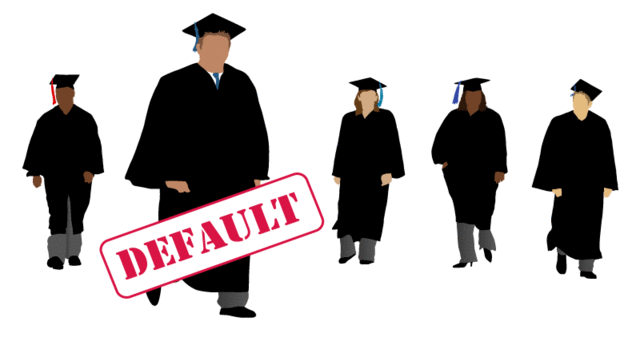
Congratulations!!! You have to start paying off your loans within the next month! YAY!!! (OK. I’m sorry for the sarcasm.) Many recent grads are still struggling to find work and making student loan payments may be tough. Despite the fact that you may unemployed or underemployed, whatever you do, do NOT default on your student loans. DON'T DO IT! DON’T…DO…IT! Not paying back your student loans can get you into a lot of financial trouble. The following things can happen if you are delinquent in your loan payments:
  • Your entire loan balance will be due immediately.
  • You lose eligibility for loan deferment.
  • You won’t be eligible for additional federal student aid. (You do want to go to grad school right?)
  • Your account will be turned over to a collection agency and you will have to pay additional charges, late fees, and collection costs.
  •  Your credit will go down the toilet. Since your credit will be trash, you might not qualify for credit cards, a car loan, a mortgage, or renting an apartment or you’ll qualify for an astronomical interest rate that will cost you more money.
  • Forget about a tax refund.
  • Uncle Sam will garnish your paycheck if you ever do find a job.
  • It may take longer for you to find a job or get a professional license if employers do credit checks.

I understand if you have bills that are high as the sky, but you have options if you cannot afford to make your student loan payments. Remember you can apply for a deferment or forbearance. You can also consolidate your loans or switch your payment plans. There is no excuse for you not to be responsible and take care of your student loans. If you don’t, it will cost you in the future. (I warned you.)

All information presented only relates to Federal student loans and is provided by the Department of Education. If you have private student loans, contact your lender(s).

Friday, October 22, 2010

Should I Consolidate My Student Loans?

Keeping up with all your different student loans can be a hassle. If you borrowed money from multiple lenders, you may have difficulty keeping up with all the due dates now that you have to start paying off your loans. One option that may help you is loan consolidation. Like many things in life, loan consolidation has its advantages and disadvantages.

Advantages

  • One payment to one lender- With consolidation, you only make one monthly payment and you have one lender- the Department of Education.
  • Lower Monthly Payment- Your payments are lower because you have longer repayment period. Under the standard repayment plan, your payment period can be up to 30 years.
  • A fixed rate- Your consolidated loan will have a fixed interest rate during the life of the loan. Your rate is based on the weighted average of all your consolidated loans. Your interest rate will not exceed 8.5%.
  • No Minimum or Maximum Loan Amounts or Fees- Consolidation is free.
  •  No penalty for paying off your loan early
Disadvantages

  • More interest- Since you have an extended repayment period, you will pay more in interest over the long term.
  • Loss of benefits. With consolidation you will longer be able to take advantage of certain incentives such as loan cancellations and interest rate reductions.
  • Higher interest rate- The interest rate on your consolidated loan may be higher than the interest rates on you individual loans.
Consolidating your loans can help you if your individual monthly loan payments are too high, but consider ALL your options before you consolidate. If your payments are too high, contact your lender and try to switch payment plans. Remember the IBR plan allows you to make monthly payments according your income. Consolidation is a good option, but consider what you give up before you consolidate your loans.

NOTE: DO NOT consolidate your federal student loans with your private student loans. When you mix the two types of loans, you loans are no longer backed by the government and you have a private lender. You lose all the benefits you have with your federal student loans when you consolidate with a private lender.

For more information about loan consolidation, visit http://www.loanconslidation.ed.gov/.

All information presented only relates to Federal student loans and is provided by the Department of Education. If you have private student loans, contact your lender(s).

Wednesday, October 20, 2010

So You Can’t Afford to Pay Your Student Loans

Since the day you gradated, the student loan people have been on your back by sending you letters every week. I have some bad news and good news for you my recent grad. The bad news is the only way you can get out of paying your student loans is if you DIE! The good news is you do have a few options if you cannot afford to pay your loans back at this time.  Here’s a breakdown of your options.


Deferment
Every graduate has a grace period of at least six months, but you can also defer your loans. A deferment is a temporary suspension of repayment on your principal loan balance for specific period of time. You do not have to pay interest on subsidized loans during deferment, but you must pay it on unsubsidized loans. If you do not pay the interest on your unsubsidized loans, it will be added to your balance and you will pay more money. You qualify for a deferment under the following conditions:
  • Enrolled in school at least part time
  • Studying in an approved graduated fellowship program or in an approved rehabilitation training program for the disabled
  • Unemployed(Deferment up to three years)
  • Economic hardship{Deferment up to three years (including Peace Corps)}
  • A member of US Armed forces reserve or the National Guard.  You must be called or ordered to active duty while in school at least part time or within six months of having been enrolled at least half-time.
Forbearance
If you do not qualify for deferment, you can apply for a forbearance. A forbearance allows you to postpone or reduce your monthly payments for a specific time period due to financial hardship or illness. You are responsible for paying the interest on both subsidized and unsubsidized loans. If you do not pay the interest, it will be added to your principal balance and you will pay more money.


Along with deferment and forbearance, there are also loan forgiveness programs.

Teacher Loan Forgiveness Program
You can get up to $17,500 of your loans cancelled under this program! You have to teach in a low income elementary or secondary school for five consecutive years. There are some conditions. To receive up to $17,500 in loan forgiveness, you must be a math or science teacher in a secondary school or a special education teacher. You receive up to $5,000 in loan forgiveness if you are an elementary teacher or secondary teacher that teaches a subject that relates to your major. If you are an aspiring educator or thinking about going into education, take advantage of this program. The world needs more great teachers.

Public Service Employees
With this program, your remaining balance can be forgiven after you made 120 payments. Only federal Direct Loans qualify for this program, but you can have your other federal student loans consolidated into a Direct Loan to take advantage of this program. You qualify for this program if you are employed full time in the following sectors:

  • A federal, state, local, or tribal government organization, agency, or entity including public schools, colleges and universities
  • A public child or family service agency
  • A 501(c)(3) non-profit organization
  • Tribal college or university
  • A private organization that is a not for-profit business, labor union, partisan political organization, or religious organization provides the following public services
    • Emergency management
    • Military service
    • Public safety, public health, public education, or public library services
    • Law enforcement
    • Public interest law services
    • Early Childhood services
    • Public service for individuals with disabilities and the elderly
    • School library or other school-based services
These programs can really work for you. For example, let’s say you have $43,000 in loans. You are a preschool teacher that makes $24,000 a year and you are single with no children. You choose the IBR plan and your loan payments are $95 a month. If you were to make 120 payments of $95, you are only paying back $11,400 of your $43,000. I understand that life circumstances could change with this example, but you still won’t pay anywhere close to your original balance. Remember people buy $40,000 cars (which depreciate in value) and pay it off in less than 10 years. If you use these programs, you don’t even pay full amount of your loans and your income will increase over time with your degree. Don’t be discouraged by your debt. Take advantage of these programs, make your payments ON TIME, and you will succeed.

All information presented only relates to Federal student loans and is provided by the Department of Education.  For more information about these programs, visit studentaid.ed.gov. If you have private student loans, contact your lender(s).

Wednesday, October 6, 2010

10 Common Money Mistakes Made by Recent Graduates

Since I'm a recent grad, I decided to do my next series on recent graduates. All my fellow recent graduates know it's hard trying survive in this rough economy. We are bound to make mistakes now that we are in the real world. I found these common mistakes from a guest post over at realmofprosperity. For each mistake, I'm going to tell whether I'm guilty or innocent.

1. Overspending on the wardrobe. Guilty
I love to shop and I get bored with my wardrobe. After struggling through college and working a minimum wage job during the summer, I felt rich once I got my first paycheck from my current job. It feel good to not worry about bills and to spend money on things I wanted. While I needed work attire, I could of bought a few pieces at a time instead of going on two shopping sprees.If you need a work wardrobe, buy a few quality pieces at a time. Use coupons and shop sales and clearances whenever you can.

2. Partying and drinking more while out of school.  I Plead the 5th.  I’m not sure where to place myself.  It’s okay to go out, but if you are fortunate to have a job just remember you have to get up for work in the morning. If you don't have a job, you can be using that money for your job search. You can spend a lot of money going to happy hours or going to clubs every weekend. It is also not wise to play Mr or Ms. Big Shot and pick up the tab for everyone.You are only fooling yourself and wasting your money. Skip happy hour sometimes and find cheaper alternative ways to have fun. Your body and wallet will thank you for it.

3. Eating out too much. Guilty.  I’m guilty because I don’t mind spending $30 or $40 on a meal. (I know, a waste.)  Eating out can be expensive and it can affect your health. Learn how to cook some of your favorite restaurant meals. It may not always taste the same, but you can control amount of calories you’re consuming and save money.

4. Buying swanky gadgets.  Innocent. Even though I want a Mac, I have not spent my savings on a new laptop. (Although my current laptop almost blew out on me.)  The money you want to use to buy a new iPhone, plasma TV, or laptop can go towards your student loan payments. Your current gadgets are good enough until you can afford to buy the latest and greatest gadgets.

5. Abusing the credit cards. Innocent. My mom yelled at me for four years, “ Don’t get a credit card cause I will not help you pay the bill!” I was a good girl and I listened. All I have to worry about is my $50,000 of student loan debt. Woo hoo!!! For those of you who have credit cards, it’s easy to get caught up and start using credit cards to pay for things. You’re making big money now so you can just pay if off later right? WRONG! Or you can use credit cards to get by until you find a job right? WRONG AGAIN! Do not abuse your credit cards with the intention of worrying about it later. Never be tempted to carry a balance on your credit card.  Always pay the full balance.

6. Not being savvy when grocery shopping.  Guilty. One tip my mom gave me to eat what was on sale. I didn’t always do this when I was living on my own. I also didn’t use coupons. Using coupons may make you feel like a soccer mom(no offense to soccer moms), but you will save money on your grocery bill. Look through the supermarket circulars to find sales and use coupon sites.

7. Celebrating with an expensive trip. Innocent. My dream last year was to backpack around the world for an entire month after graduation. Good thing my money did not allow me because I was able to focus on my career. As recent graduates, we do feel entitled to a trip after putting our blood, sweat, and tears into getting a degree, but it may not be the best idea. Vacations cost money that you may not have and you need to focus on starting your career. You will have plenty of time to travel and enjoy the good life once you are established in your career.

8. Purchasing a new set of wheels. Innocent. I am driving the purple bucket that my dad left me. I hate my clunker as much as the next college grad, but buying a new car can become a financial burden. Buying a new car gives you more debt on top of your student loans and credit cards. A new car also depreciates in value as soon as you drive it off the lot. Get as many miles off your clunker and drive it until the wheels fall off. If you must buy a new car, buy a gently used car.

9. Renting a new crib by yourself. Innocent. While it may be nice to have a place all to yourself, a roommate cuts expense. You might be tired of living with other people, but you save money in the long run. You can put that extra money into savings for a house. You can also do what I did and move back in with your parents for awhile. Mom and Dad might nag you, but dealing with them allows you to save for a house too.

10. Forgetting to save for retirement. Guilty. When you are young, retirement seems sooooooo far away, but it’s important to start early. If you start saving now, you will have a lot more money than someone who starts saving in their 30s or 40s. Sign up for your company’s 401k plan especially if they match your contributions. If your company does not offer retirement plans, you can set up a Roth IRA. Since I haven’t found a permanent position, I am looking into various Roth IRAs offers.

I’ve been charged with four counts of recent grad mishaps. I guess I’ll start serving my sentence now-sticking to my spending plan and researching IRA accounts. What mistakes have you made as a recent grad?

Contributors: Mr Credit Card www.askmrcreditcard.com.