Showing posts with label recent grads. Show all posts

Monday, October 25, 2010

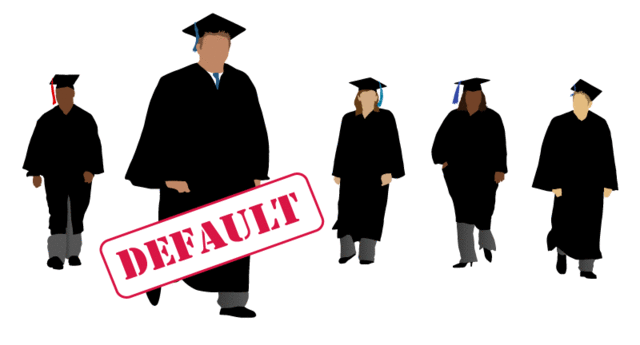
Don’t Default on Your Student Loans!

Congratulations!!! You have to start paying off your loans within the next month! YAY!!! (OK. I’m sorry for the sarcasm.) Many recent grads are still struggling to find work and making student loan payments may be tough. Despite the fact that you may unemployed or underemployed, whatever you do, do NOT default on your student loans. DON'T DO IT! DON’T…DO…IT! Not paying back your student loans can get you into a lot of financial trouble. The following things can happen if you are delinquent in your loan payments:
  • Your entire loan balance will be due immediately.
  • You lose eligibility for loan deferment.
  • You won’t be eligible for additional federal student aid. (You do want to go to grad school right?)
  • Your account will be turned over to a collection agency and you will have to pay additional charges, late fees, and collection costs.
  •  Your credit will go down the toilet. Since your credit will be trash, you might not qualify for credit cards, a car loan, a mortgage, or renting an apartment or you’ll qualify for an astronomical interest rate that will cost you more money.
  • Forget about a tax refund.
  • Uncle Sam will garnish your paycheck if you ever do find a job.
  • It may take longer for you to find a job or get a professional license if employers do credit checks.

I understand if you have bills that are high as the sky, but you have options if you cannot afford to make your student loan payments. Remember you can apply for a deferment or forbearance. You can also consolidate your loans or switch your payment plans. There is no excuse for you not to be responsible and take care of your student loans. If you don’t, it will cost you in the future. (I warned you.)

All information presented only relates to Federal student loans and is provided by the Department of Education. If you have private student loans, contact your lender(s).

Friday, October 22, 2010

Should I Consolidate My Student Loans?

Keeping up with all your different student loans can be a hassle. If you borrowed money from multiple lenders, you may have difficulty keeping up with all the due dates now that you have to start paying off your loans. One option that may help you is loan consolidation. Like many things in life, loan consolidation has its advantages and disadvantages.

Advantages

  • One payment to one lender- With consolidation, you only make one monthly payment and you have one lender- the Department of Education.
  • Lower Monthly Payment- Your payments are lower because you have longer repayment period. Under the standard repayment plan, your payment period can be up to 30 years.
  • A fixed rate- Your consolidated loan will have a fixed interest rate during the life of the loan. Your rate is based on the weighted average of all your consolidated loans. Your interest rate will not exceed 8.5%.
  • No Minimum or Maximum Loan Amounts or Fees- Consolidation is free.
  •  No penalty for paying off your loan early
Disadvantages

  • More interest- Since you have an extended repayment period, you will pay more in interest over the long term.
  • Loss of benefits. With consolidation you will longer be able to take advantage of certain incentives such as loan cancellations and interest rate reductions.
  • Higher interest rate- The interest rate on your consolidated loan may be higher than the interest rates on you individual loans.
Consolidating your loans can help you if your individual monthly loan payments are too high, but consider ALL your options before you consolidate. If your payments are too high, contact your lender and try to switch payment plans. Remember the IBR plan allows you to make monthly payments according your income. Consolidation is a good option, but consider what you give up before you consolidate your loans.

NOTE: DO NOT consolidate your federal student loans with your private student loans. When you mix the two types of loans, you loans are no longer backed by the government and you have a private lender. You lose all the benefits you have with your federal student loans when you consolidate with a private lender.

For more information about loan consolidation, visit http://www.loanconslidation.ed.gov/.

All information presented only relates to Federal student loans and is provided by the Department of Education. If you have private student loans, contact your lender(s).

Wednesday, October 20, 2010

So You Can’t Afford to Pay Your Student Loans

Since the day you gradated, the student loan people have been on your back by sending you letters every week. I have some bad news and good news for you my recent grad. The bad news is the only way you can get out of paying your student loans is if you DIE! The good news is you do have a few options if you cannot afford to pay your loans back at this time.  Here’s a breakdown of your options.


Deferment
Every graduate has a grace period of at least six months, but you can also defer your loans. A deferment is a temporary suspension of repayment on your principal loan balance for specific period of time. You do not have to pay interest on subsidized loans during deferment, but you must pay it on unsubsidized loans. If you do not pay the interest on your unsubsidized loans, it will be added to your balance and you will pay more money. You qualify for a deferment under the following conditions:
  • Enrolled in school at least part time
  • Studying in an approved graduated fellowship program or in an approved rehabilitation training program for the disabled
  • Unemployed(Deferment up to three years)
  • Economic hardship{Deferment up to three years (including Peace Corps)}
  • A member of US Armed forces reserve or the National Guard.  You must be called or ordered to active duty while in school at least part time or within six months of having been enrolled at least half-time.
Forbearance
If you do not qualify for deferment, you can apply for a forbearance. A forbearance allows you to postpone or reduce your monthly payments for a specific time period due to financial hardship or illness. You are responsible for paying the interest on both subsidized and unsubsidized loans. If you do not pay the interest, it will be added to your principal balance and you will pay more money.


Along with deferment and forbearance, there are also loan forgiveness programs.

Teacher Loan Forgiveness Program
You can get up to $17,500 of your loans cancelled under this program! You have to teach in a low income elementary or secondary school for five consecutive years. There are some conditions. To receive up to $17,500 in loan forgiveness, you must be a math or science teacher in a secondary school or a special education teacher. You receive up to $5,000 in loan forgiveness if you are an elementary teacher or secondary teacher that teaches a subject that relates to your major. If you are an aspiring educator or thinking about going into education, take advantage of this program. The world needs more great teachers.

Public Service Employees
With this program, your remaining balance can be forgiven after you made 120 payments. Only federal Direct Loans qualify for this program, but you can have your other federal student loans consolidated into a Direct Loan to take advantage of this program. You qualify for this program if you are employed full time in the following sectors:

  • A federal, state, local, or tribal government organization, agency, or entity including public schools, colleges and universities
  • A public child or family service agency
  • A 501(c)(3) non-profit organization
  • Tribal college or university
  • A private organization that is a not for-profit business, labor union, partisan political organization, or religious organization provides the following public services
    • Emergency management
    • Military service
    • Public safety, public health, public education, or public library services
    • Law enforcement
    • Public interest law services
    • Early Childhood services
    • Public service for individuals with disabilities and the elderly
    • School library or other school-based services
These programs can really work for you. For example, let’s say you have $43,000 in loans. You are a preschool teacher that makes $24,000 a year and you are single with no children. You choose the IBR plan and your loan payments are $95 a month. If you were to make 120 payments of $95, you are only paying back $11,400 of your $43,000. I understand that life circumstances could change with this example, but you still won’t pay anywhere close to your original balance. Remember people buy $40,000 cars (which depreciate in value) and pay it off in less than 10 years. If you use these programs, you don’t even pay full amount of your loans and your income will increase over time with your degree. Don’t be discouraged by your debt. Take advantage of these programs, make your payments ON TIME, and you will succeed.

All information presented only relates to Federal student loans and is provided by the Department of Education.  For more information about these programs, visit studentaid.ed.gov. If you have private student loans, contact your lender(s).

Friday, October 15, 2010

Paying Off your Student Loans


For those of you who graduated in May 2010, your grace period is quickly coming to an end. I’m sure you receive letters from your student loan creditors every other week.  Although you wish your debt would just go away, you have to pay off your student loans (unless you want your credit to go down the toilet.)  The Department of Education has several payment plans to help you pay off your debt. Here is a breakdown of some of the most common plans.

Standard
This plan gives you 10 years to pay off your debt. Your monthly payment will be a fixed amount of at least $50. You may have a higher payment with this plan, but you will pay less in interest since you have a shorter payment period.

Extended
Under this plan, you have 25 years to pay off your loans. You will have a lower payment, but you will pay more in interest because you have a longer repayment period. There are some restrictions with this plan. If Direct Loan is your creditor, you must have more than $30,000 in Direct Loans. If FFEL (Federal Family Education Loan) is your creditor, you must have more than $30,000 in FFEL Program loans.

Graduated
With this plan, your payments start out low and increase every two years. This plan also gives you 10 years pay off your loans. This plan is good if you expect your income to steadily increase over time.

Income Based Repayment Plan (IBR)
The Income Based Repayment Plan started in 2009. Under this plan, your payment is based on your income and family size. You are eligible for this plan if your monthly payment is lower under IBR than under the standard plan. This plan also comes with a few incentives. If you repay under IBR for 25 years and meet other requirements, your remaining debt can be cancelled.  If you work in public service and repay under IBR, your remaining debt can be cancelled after 10 years in public service. While this plan does have incentives, it also has disadvantages. Because you are making a lower payment, you may pay more in interest. You also have to send your lender documentation about your income and family size every year. You can get an estimate of your payment under this plan by using IBR caluclator.
For more information on all these plans, visit nslds.ed.gov.


NOTE: Paying off your student loans may feel overwhelming, but remember you made an investment in yourself. People pay $50,000 for a luxury car that depreciates as soon as they drive it off the lot and pay it off within 5 to 10 years. Your earnings and career appreciate overtime with your degree. Don’t stress, make your payments on time, and focus on your new career.

All information presented only relates to Federal student loans and is provided by the Department of Education. If you have private student loans, contact your lender(s) for repayment options.